
The Cycle of Love: The Artist Who Cycled from India to Sweden
What would you do if the person you loved was thousands of miles away and you had no money for a plane ticket?
For PK Mahanandia, the answer was simple: he bought a bicycle.
It sounds like the beginning of a film, but it really happened.
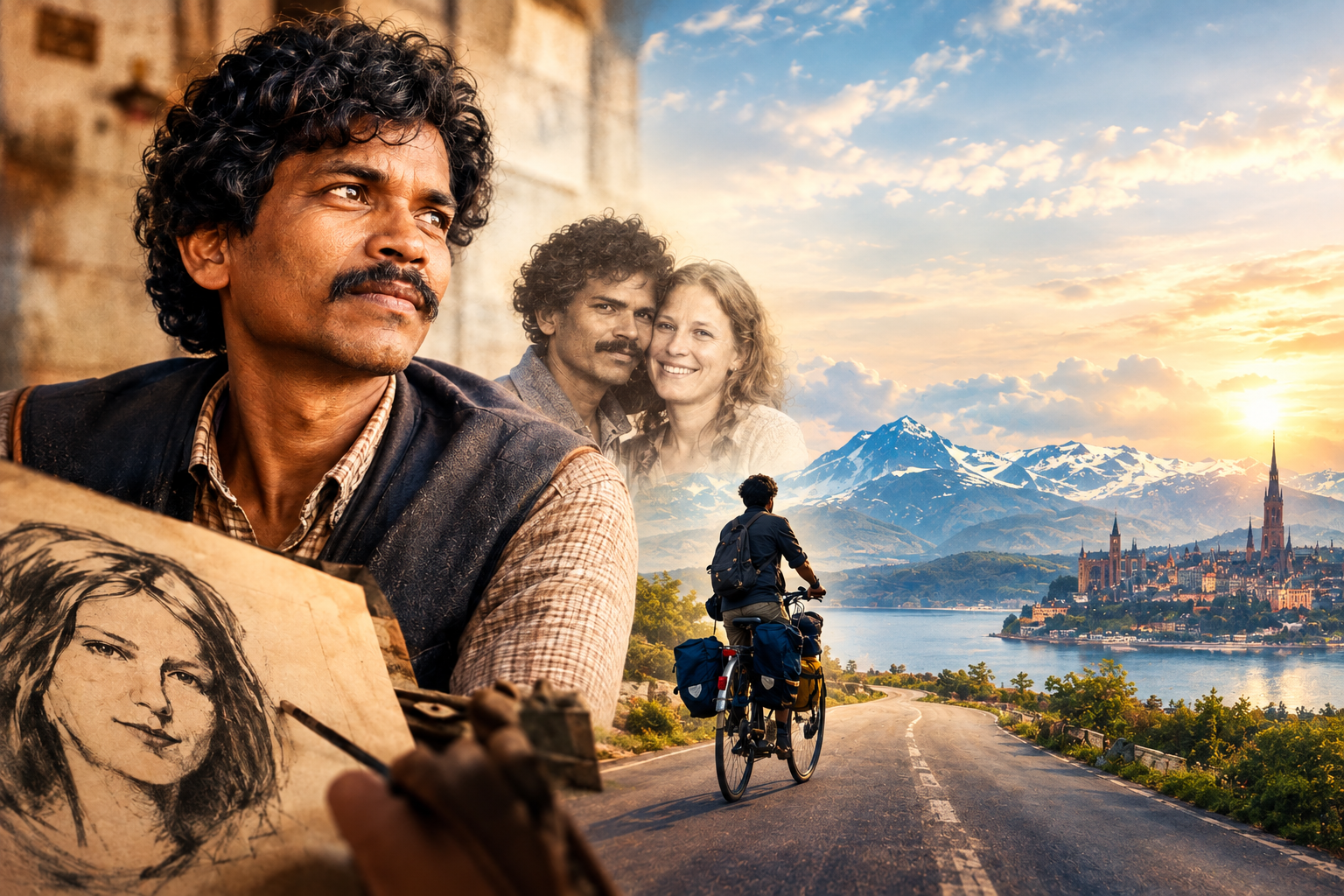
PK was a young artist in Delhi when he met Lotta von Schedvin, a Swedish woman who had come to India. In December 1975, Lotta sat down in Delhi to have her portrait drawn by PK. The portrait took only a short time, but the meeting changed both of their lives.
When Lotta eventually returned to Sweden, PK wanted to be with her. He could not afford to fly there, so in January 1977 he set off on a second-hand bicycle, carrying his art supplies and very little money.
His destination was Sweden.
The journey covered thousands of miles and took him across several countries. Along the way, his ability as an artist helped him survive. He drew portraits for people he met, receiving money, food and help in return.
This is the story behind The Cycle of Love, the new documentary directed by Orlando von Einsiedel. The film tells the story of PK and Lotta through their memories, interviews and recreated scenes.
But there is more to PK’s story than the bicycle journey.
The Portrait That Started Everything
It is interesting to think about how this story began.
There was no long journey at the beginning. There was no grand plan. There was simply an artist sitting in Delhi, drawing a portrait.
PK made a living from his art. Drawing was something he knew how to do, and it gave him a way to earn money while studying and building his life.
Then Lotta came along.
According to accounts of their story, she had travelled to India and wanted PK to draw her portrait. They met, talked and quickly developed a relationship. Lotta later returned to Sweden, but the two continued to keep in touch through letters.
It is remarkable that something as ordinary as a portrait could lead to such an extraordinary journey.
And perhaps that is one of the things we like about this story.
PK Was an Artist Before He Was a Traveller
When people hear about PK Mahanandia today, they often hear the bicycle story first.
The Indian artist who cycled to Sweden for love.
It is a great headline, but it can also make us forget the person behind it.
PK was an artist long before he became known for his journey. He studied art and made a living by drawing portraits in Delhi. His artistic ability was an important part of his life.
It also became important during his journey.
PK did not simply leave India with a bicycle and hope for the best. His art was one of the things he could take with him. He could sit down somewhere, draw a person’s portrait and earn enough to continue travelling.
That detail has always stood out to us.
A skill that he had developed as an artist became something that helped him cross countries.
A Dalit Artist’s Story
PK’s background is another important part of his story.
He was born into a Dalit family in India and experienced caste discrimination while growing up. His journey from his early life to becoming an artist in Delhi was not an easy one. His experiences with caste and social exclusion are also part of what the documentary explores.
This is something that can easily get lost when the story is reduced to a romantic adventure.
PK was not simply a man riding a bicycle to find the woman he loved.
He was also a young Dalit artist who had spent years trying to build a life through his talent.
That makes his story particularly interesting from an Indian perspective. It brings together love, art, caste, opportunity and the desire to create a different life.
For us at Dalit Goods, the connection with artisans and artists is important here.
We often talk about the products people make, but it is worth remembering that every handmade object starts with a person and a skill.
The Skill Behind the Work
Think about a handmade product for a moment.
You might see a candle, a piece of pottery, a painted decoration or a handmade gift.
What you see is the finished product.
The maker sees something different.
They know how much practice went into making it. They know the techniques they learned. They may have learned those skills from a parent, grandparent or someone in their community.
And, just like PK’s portraits, that skill can also be a way of earning a living.
This is one reason we find stories about Indian artisans so interesting.
The object is only part of the story.
There is also the person who made it.
The Journey to Sweden
In January 1977, PK finally decided to make the journey to Sweden.
He sold his belongings, bought a second-hand bicycle and started travelling west. He carried his art materials with him and used his drawing skills along the way.
His route took him through parts of Asia and into Europe. He travelled for months before finally reaching Sweden and reuniting with Lotta. Accounts of the journey differ on the exact distance, with estimates ranging from around 4,000 to 6,000 miles, but there is no question that it was an extraordinary journey.
What I find particularly interesting is that PK continued to use his art during the journey.
He did not leave one life behind and suddenly become someone completely different.
He remained an artist.
The bicycle simply took his art — and him — much further than he could have imagined.
Why This Story Still Matters
PK and Lotta’s story began more than 50 years ago, but it still feels surprisingly relevant.
People still leave their homes to build new lives.
Artists still make a living from their skills.
Traditional crafts are still passed between generations.
And people still form relationships with others from completely different backgrounds and cultures.
The world has changed enormously since the 1970s. We now have smartphones, video calls and cheap flights.
PK had none of those things.
When Lotta went back to Sweden, they had letters.
And when PK eventually decided that letters were not enough, he had a bicycle.
There is something quite extraordinary about that.
The People Behind the Things We Buy
At Dalit Goods, this is the part of PK’s story that interests us most.
We sell handmade products, but we don’t want to think of them as simply products.
There are people behind them.
There are artisans with skills that have often been developed over many years. There are traditional techniques, local materials and stories connected to different parts of India.
When you buy something handmade, you are not just buying the finished object.
You are also buying something that someone spent time making.
That human element can easily disappear when everything is mass-produced and shipped around the world.
PK’s story is a good reminder of why it is worth looking beyond the finished piece and thinking about the person who created it.
Art Can Take You Further Than You Expect
PK probably could not have imagined where that portrait in Delhi would eventually lead.
One portrait led to a relationship.
The relationship led to a journey.
The journey took him across countries and eventually to Sweden.
And decades later, the story has become a documentary watched by audiences who may never have heard of PK before.
That is quite a journey for a portrait.
It also says something about the power of creative work.
Art can be a job. It can be a tradition. It can be a way to express yourself.
And sometimes it can open a door that you never expected to walk through.
The Cycle of Love
The Cycle of Love brings PK and Lotta’s story back into the spotlight. The documentary, directed by Orlando von Einsiedel, combines interviews and recreated scenes to tell the story of the couple and the remarkable journey that brought them together in Sweden. It was released in UK cinemas on 18 September 2026.
For us, though, the most interesting part of the story may still be where it started.
With an artist.
With a portrait.
And with the simple idea that something made by hand can connect two people who otherwise might never have met.
That is something we think about at Dalit Goods too.
Behind every handmade product is a person.
Behind every traditional craft is a skill.
And behind many of those skills is a story.
PK Mahanandia’s story is an extraordinary one, but perhaps the idea behind it is quite simple:
Sometimes, you have to look beyond the thing itself to discover the person who made it.
Discover the Stories Behind Indian Craftsmanship
At Dalit Goods, we work with handmade products connected to Indian artisans and traditional craftsmanship.
If PK’s story has made you curious about the people and traditions behind handmade work, take a look at Dalit Goods and discover some of the craftsmanship and stories behind our collections.
FAQs About The Cycle of Love
What is The Cycle of Love about?
The Cycle of Love is a documentary about the true story of Indian artist PK Mahanandia and Swedish woman Lotta von Schedvin. The film follows their meeting in Delhi, their relationship and PK’s extraordinary bicycle journey from India to Sweden.
Who is PK Mahanandia?
PK Mahanandia is an Indian artist who became known internationally for cycling from India to Sweden in 1977 to reunite with Lotta von Schedvin, the Swedish woman he loved. He was a portrait artist in Delhi before making the journey.
How did PK Mahanandia meet Lotta von Schedvin?
PK Mahanandia met Lotta von Schedvin in Delhi in 1975 when she visited him to have her portrait drawn. Their meeting became the beginning of their relationship.
Is The Cycle of Love based on a true story?
Yes. The Cycle of Love is based on the real-life story of PK Mahanandia and Lotta von Schedvin. Their relationship and PK’s journey from India to Sweden form the central story of the documentary.
Why did PK Mahanandia cycle to Sweden?
PK Mahanandia travelled to Sweden by bicycle because he wanted to reunite with Lotta after she returned to Sweden. Unable to afford a plane ticket, he decided to make the journey overland by bicycle.
How far did PK Mahanandia travel by bicycle?
PK Mahanandia travelled about 6,000 miles from India to Sweden in 1977, crossing multiple countries before reaching Sweden.
Was PK Mahanandia an artist?
Yes. PK Mahanandia was a portrait artist in Delhi. His artistic skills were also important during his bicycle journey, as he drew portraits for people he met along the way.
Was PK Mahanandia a Dalit artist?
Yes. PK Mahanandia was born into a Dalit family in India and experienced caste-based discrimination during his early life. His background and experiences are an important part of his life story and the documentary.
Who directed The Cycle of Love?
The Cycle of Love was directed by filmmaker Orlando von Einsiedel. The documentary combines the real-life story of PK and Lotta with interviews and recreated scenes.
When was The Cycle of Love released in the UK?
The Cycle of Love was released in UK cinemas on 18 September 2026.
What makes The Cycle of Love different from a typical love story?
The documentary combines a love story with PK Mahanandia’s life as an artist, his experience as a Dalit man and his extraordinary bicycle journey from India to Sweden. It also explores themes of identity, culture, distance and human connection.
What role did art play in PK Mahanandia’s journey?
Art was an important part of PK Mahanandia’s life and livelihood. He was working as a portrait artist when he met Lotta, and he also used his drawing skills during his journey to Sweden, drawing portraits for people he encountered along the way.